

End of the world
Gaming’s ‘invisible wall’ might not be the dead end that we think it is.
Cast your mind back to the very first time you laid hands on a 3D platformer. For most, it was probably Super Mario 64. Remember looking up and seeing the castle? All you wanted to do was go to that castle, and after a few manic leaps and cartwheels, you bolted across to the big white wall and jumped at it for a while. Then you spot the moat, and without even thinking-bolstered by the exhilaration of having spent half an hour throwing yourself against a wall-you dive in. You’re swimming! Rad. You can touch the bottom! This is brilliant. What’s this? The moat is a river? Wow! Wait, there’s a pond at the end of the river? Fantastic! What’s that in the distance? An island? Let’s get out there!
Bump.
Wait! Stop. Get a proper grasp of the controls. Swim across to the bank, onto the grass, back in the water. To the island!
Bump.
It’s right under your nose, but you can’t reach it. No matter how hard you try.
Welcome to your first invisible wall.
We’re used to games putting the best stuff being beyond our reach. There wasn’t a text adventure that didn’t depict a rolling vista to the north, only to tell us “you can’t go that way”. The mountains of Io were visible through Doom’s windows and beyond its walls; the futuristic cities of F-Zero stretched forever below the suspended track. But we always knew it was just decoration. We understood that a theoretically endless environment is too much for a console to generate, let alone a developer to build.
Game worlds are tightly constructed entities-every structure an integral piece of the puzzle-and to keep players within bounds a game will ideally use clever design to give gentle nudges in the right direction. Brick walls, slippery slopes, electric fences, floating worlds, inexplicably fatal snow-all effective hints that there’s no wandering beyond this point. Just as a key looks like it will open a lock, a wide moat full of poisonous green goop might as well be an enormous sign reading ‘WORLD ENDS HERE’. Even the most tenacious player will begrudgingly get the hint and move on.
However, by definition invisible walls don’t offer any guidance. Nothing tells you with any certainty that, no, you can’t go that way. You’re teased with an enticing stretch of something. Anything. Grass, ocean, forest. And it calls you. It presents new possibilities and beckons you to explore, only to stop you in your tracks.
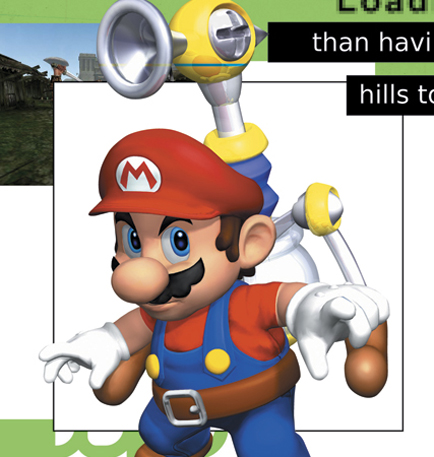
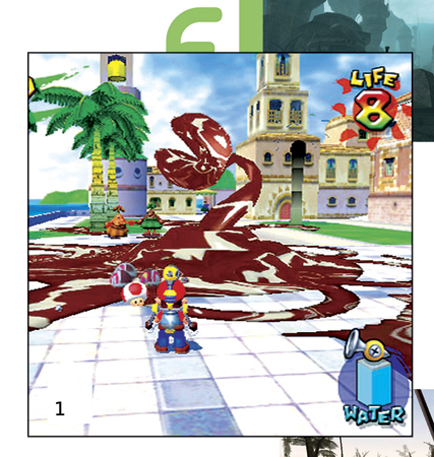
Those familiar with Sonic Adventure’s Station Square will know the frustration of seeing beaches, roads and underground car parks, all cordoned off by nothing. Super Mario Sunshine even puts adjacent play areas within easy reach of each other, but the same magical force-field keeps players in check. (Of course, these levels do eventually come into play, but not directly; the player is sucked into a wacky vortex and spat out the other end). The thing is, though, that a shoal or fence would conclusively tell players there’s no path between islands. Sure, a non-playable character might tell you that completing the first mission will get you over there, but how many of us stop to chat before exploring? Who reads the manual before setting up the new widescreen telly? The fun is in feeling your way.
Although Sunshine is fundamentally all about platforming action, exploration is a crucial factor, and this forced modularity undermines its implied freedom. The Legend of Zelda is successful because a powerful sense of accomplishment comes from making one’s way across the landscape. In the first few hours of The Ocarina of Time, Link has no choice but to traverse the massive play area on foot, and it doesn’t matter, because it’s huge and rich and varied and full of fun things to collect and kick. Furthermore, at the perimeter of each environment is a steep mountain or cliff face, so the player doesn’t waste hours running at the edges like a big tool. If Hyrule Field were fenced off and packed with teleport devices and invisible walls, there’d be great wads of frustration and no adventure, and the game would be over in half the time, the player feeling considerably short-changed.
Sadly, in broader gaming the invisible wall is now so common that it’s become tacitly accepted as a valid rule of game design. We hit the wall, quietly shrug and continue exploring. Banjo-Kazooie used this de facto convention to its advantage with Sharkfood Island, which the player can see, and even swim up to, but not touch. The plan was to grant access via some deft technical trickery in the sequel, but this never eventuated, and Sharkfood Island remains permanently just out of reach. This is a particularly egregious piece of design because, unlike other parts of the game that are visibly boarded up for the same purpose, there’s no visual cue suggesting that it’s out of bounds, and there’s no way to know without trying to get to it. It feels like a bug.
But what happens when you are given unconditional access to a vast world? The Elder Scrolls III: Morrowind is the answer. The play area is unbelievably, mouth-wateringly, freaking enormous. And as if that isn’t enough, you’re promised no limits; and for once that’s exactly what you get. See the forest in the distance? A quick stroll. That rocky outcrop high in the air? Simply levitate to the top. In a fit of pique you can even run to the nearest shore line, jump into the water and swim in a random direction for hours, (even though you know there’s nothing out there), because there’s no-one telling you where you can and can’t go. There really are no boundaries; you can go quite literally wherever you like.
After giving 100 hours of your life to Morrowind, it’s safe to say that you will know every feature of the game world in exquisite detail. You’ve run up every hill, floated to the top of every fortress, dived into every river and lake. The mystery’s evaporated; the magic’s gone. Red Mountain’s overpowering majesty becomes about as enigmatic as your local milk bar, and travelling there as captivating as the drive to work. You’re on the other side, but the grass isn’t greener; in fact it’s depressingly banal.
And herein lies the rub. Good old-fashioned sensibility dictates that the vastness of a game world is inversely proportionate to how interesting it is, simply because the sheer amount of time and resources required for such a task would break every fundamental rule of economics. The PS3, for example, probably wields enough grunt to create expanses the like of which nobody has ever seen, but no sane developer will commission a world as large as FFX and as dynamic as Ratchet & Clank. It’s far more lucrative to release several small games than a single huge one.
So, ultimately the choice is between intricacy and girth, and it seems to me that developers address this by creating small, entertaining levels, adorning the void with skyscrapers, and choosing not to opaquely fence off the borders, hoping the worlds feel more open than they really are.
Taking into account past experience and harsh reality, are we better served by this? Should we be able to visit any feature of the landscape, barren and featureless as it might be, or is it more satisfying to stand at the end of the world and stare longingly into the distance?Is the impossible horizon really more frustrating than having to climb 16 arbitrary hills to get to the nearest town?
Perhaps we should not curse but thank designers for leaving us wanting more, and enjoy the fact that these hidden barriers exist as a favour to us, to enrich the game world and stoke our imagination.
Words: Adam Davies
Art: Jonathan Read


Talking about invisible walls, what about the good old invisible holes?
I remember back on the old Master System II, when I actually had time to play through every possible scenario in a game. I used to run along the length of every barrier, or wall looking for an invisible hole that could lead to an easter egg or a cool bug. The sonic games were particularly great for doing this. There were all kinds of weird things you could do – both deliberately designed (hidden levels) and accidental (being able to walk to the end of a level by jumping beyond the visible platforms). Replaying games many times just to discover these secrets was one of my favourite parts of the game experience.
Today we have exploits like duping in Elder Scrolls or using mods to hack the game engine. Now that game worlds are increasingly ‘real’ with fewer barriers to movement it’s a lot harder for a casual gamer to find the invisible holes.