
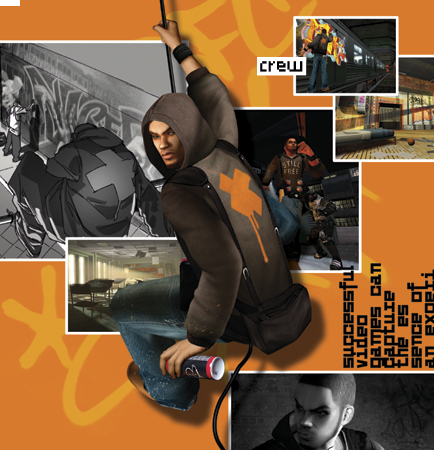
Spray to win
Catch a train to just about any inner-city destination and you can’t miss the handiwork of the graf artist. It’s big, it’s bold, it’s mired in a history of criminal activity and artistic expression, and more than a little of it is undeniably incredible.
Set the task of translating an entire culture into the vision laid out by style magnate Marc Ecko, game studio The Collective had their work cut out for them with Getting Up: Contents Under Pressure.
In an interview which took place before all of the classification controversy, lead designer John Manley talked to JumpButton about graffitti, beat downs, and a studio that knows how to have fun.
JumpButton: Okay. So, you’re faced with making the most authentic urban street game ever, based on graf culture… How in the world does a group of game designers prepare for a project like Getting Up?
John Manley: We ventured on many research trips to New York to visit the famous neighbourhoods where graffiti was born. We also hung out with a number of the world’s best-known graffiti legends and heard numerous stories of graf lore that provided inspiration for some of our gameplay missions.
JBTN: Visually and conceptually, Marc Ecko obviously had some pretty strong ideas on what this game should be like, having previously hired a full-time illustrator to flesh out his initial concepts. What did Ecko bring to the table?
JM: Marc always stressed to ‘keep it real’. This was the mantra that The Collective used when we approached our designs for the environments, characters and especially the graffiti gameplay.
JBTN: Graf artists consider their culture sacred and, in a recent interview, Ecko said, ‘You don’t f*ck with graf culture’. How much pressure did that place on the project and what you did?
JM: Once we immersed ourselves in the culture of graffiti, we all had a much greater understanding and respect for the craft of graf. This allowed us to portray the subject matter in the game with a deeper appreciation. So when we built the graffiti gameplay, we took into consideration such concepts as ‘fat caps’ (wider nozzles for large areas) and ‘skinny caps’ (thinner nozzles for outlines and detail), can control, drips, and the skills it takes to get up a two-colour ‘throwie’ vs a multicolour ‘burner’ vs a huge top-to-bottom mural on the side of a subway train.
This respect for graffiti culture is also reflected in the dialogue that our characters speak, in the clothes they wear, in the details of their ‘black books’ and in their postures when they do graffiti. The entire experience is cut from a cloth of urban authenticity. We made the effort to make sure it wasn’t a cheesy ‘Sprite Commercial’ depiction of the culture.
JBTN: Physical challenge # 1: Describe the game Getting Up without using the words ‘ground-breaking’ or ‘graffitti’.
JM: Genre-defining. The first title that draws influence from urban culture without exploiting it.
JBTN: In a press release it’s stated that Ecko has enlisted 50 of the world’s most elite graf artists to help with the look of the game. Can you tell us who some of them are, and how their work has been incorporated?
JM: Getting Up features the art of 50 of the world’s top graffiti artists, such as BANKSY, DAZE, REAS, KAWS, MODE2, DELTA, EWOK and TATS CRU.
We also have six graffiti legends who portray themselves in the game: FUTURA, COPE2, SMITH, SEEN, T-KID AND SHEPARD FAIREY (OBEY). Each of these 56 artists have a signature piece of graffiti located in one of the levels of the game, and a gameplay objective for the player is to capture a digital photograph of each legend’s piece to add it to his black book.
We also worked closely with the graf legends to assure that their pieces appeared in our environments in the same types of tag spots they would hit in real life.
JBTN: Were any of the artists Australian? And did the sizable graf scene down here provide any reference for the game?
JM: I don’t believe any of the legends in our game hail from Australia. Sorry…
JBTN: The city of New Radius (in which the game is set) has been described as Kowloon meets New York. Tell us about what we might see, and how you achieved its particular look.
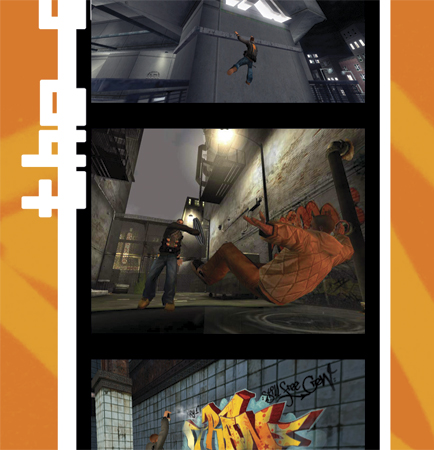
JM: The urban look in Getting Up is a progression of locations including inner-city apartments, high-rise downtown centres, and even the famous Meat Packing District (NY). We did this as a parallel to the real history of graffiti, first taking the player to the underground subway tunnels, than to above-ground tag spots, and eventually to the high-visibility ‘heaven spots’ of the city. We designed the environments to follow the main character’s growth as a graffiti artist, taking him from the underground to high above the city.
New Radius is a multicultural landscape, borrowing from the great urban centres of the world such as New York or Chicago, the stacked urban geography of Kowloon, and influences from the US West Coast freeway culture. The detail of our world was created through observation and good research. All of the environments from the Meat Packing District to the NYC Projects and Bridges were heavily photo sourced.
We also worked with a company called Ammirati who created all of the logos, signage and advertisements for New Radius which helped to create our own ‘alternate reality’ universe, but also kept us grounded with believable urban cues.
JBTN: Physical challenge # 2: List the three weirdest graf terms you’ve encountered since working on this project. Give their meanings.
JM: VAMP: To get severely beat down by a rival graffiti writer or crew, where they take all your graffiti aupplies away from you.
BEEF: To have a disagreement or conflict with another graffiti artist.
THROW-UP: A quickly executed graffiti piece consisting of a simple outline with or without a thin layer of spray paint for fill-in. Usually made with only two colours.
JBTN: Credibility; authenticity; audaciousness; danger. Graf culture has a lot of emotive connections. How did you capture this in the gameplay?
JM: We considered many of the deviant ways that real graf artists get into and out of these types of hot situations. The game allows for the player to experience these dangerous ‘vandal fantasies’ by providing ample amounts of pressure that the player must perform under. This pressure comes in the form of relentless cops, rival graf crews, time and even gravity.
JBTN: Tell the truth now… Did you ever think that if you got some artist’s graf mucked up, you were going to find yourself on the wrong end of a drive-by?
JM: Maybe a beat down, but not a drive-by. Graffiti writers are not gang-bangers, though they’re not punks either!
JBTN: Through the story, the main character, Trane, moves from a selfish, ‘me’-centred world view to a ‘we’ based one. How important was the game’s narrative in creating the gameplay and the look?
JM: The narrative of Trane’s journey from ‘Toy’ to ‘Legend’ was woven closely with the major beats of the gameplay progression. As Trane’s message becomes more political and anti-government, the pressure brought to bear on him becomes greater through the increased skill of the enemy threats, and by the higher-risk stunts that the player must perform to get up the pieces that bring him major amounts of ‘rep’. The game’s storyline also provides the player with a series of ever-increasing spectacular settings.
JBTN: ‘Getting up’ a graf piece in real life can sometimes be slow. How have you worked the spray mechanic in the game in order to move the experience along? And how does that fit with the ‘Get In; Get Up; Get Out’ concept?
JM: Successful videogames—as with movies and TV shows—can capture the essence of an experience while simultaneously taking the chore out of the real life task. In Getting Up, we needed to deftly balance the gameplay between a ‘fantasy, push-button’ experience and a ‘graffiti simulator’. Putting up a piece of graf is much faster in the game than in real life, but we captured all of the cultural elements that makes for a compelling graf experience, such as ‘underspray’ (blotchy art) vs ‘overspray’ (drips), arm movement, ‘can shaking’, and scaling up a piece to ‘go big’ for extra rep.
The added pressure of getting up a clean piece is in the player’s ability to stealthily ‘Get In’ to a prime graffiti sweet spot without being seen, ‘Get Up’ your piece while not getting killed by falling from a ‘heaven spot’ or from being shot by the police, and ‘Get Out’ of the situation without getting caught.
JBTN: You’ve recently won awards for the music in your games. How important is the music in Getting Up to conveying ‘a feel’?
JM: The music in Getting Up provides an authentic urban soundscape to the title. The vibe comes from a diverse collection of urban artists, not just cliché hip-art tracks. We feature a wide collection of sounds including electronic, rock, hip-hop and blues. This gives the game more of a movie soundtrack feel.
JBTN: Many people collaborated on this project, including some heavy names within the industry. How have you managed to make your own mark on the look and feel of the game?
JM: While many talents have teamed up to make Getting Up an innovative venture, The Collective’s strength has always been in making great-looking games that are fun to play. We expanded upon the concept of being a graffiti artist who ‘gets up’ in this gritty, paranoid world and turned it into compelling gameplay. That’s what we do best.
JBTN: ‘Verticality’ (a visceral sense of being high off the ground) was one of the big design considerations for this project. How has that been resolved?
JM: Every environment was designed as a jungle gym for Trane to explore. We wanted to compel the player to see the non-pedestrian ways to get up. So a metal girder or pipe becomes a ladder, freeway signs become canvases, and air conditioning units become stepping stones to hard-to-reach graffiti spots.
JBTN: What’s been the best part of working on Getting Up?
JM: Creating a gameplay experience that’s never been done before. Working on a title that could do for graffiti what Tony Hawk did for skateboarding. Oh yeah, and the cool Ecko schwag!
JBTN: Physical challenge # 3: In 3,000 words or less describe the socio-political importance of the subway art/style wars era, providing cultural references to the emergence of hip hop as a mainstream music genre. Or, you know, just go on to the next question…!!
JM: It’s fun to tag moving subways (which you can do in Getting Up)!
JBTN: ‘Sodas, donuts, barbecues’, ‘a killer Xmas party’ (quoted from your web site), the opportunity to work on the Star Wars franchise and a ground-breaking graf game… Seriously, how much fun can one collective have?
JM: It’s been a great experience for everyone at The Collective to work on such important projects as these.

Is this game going to be made available, even in a watered down version at some stage in the future Drew?